
Oscar Alemán
Argentine jazz guitarist who led Josephine Baker's band.

Dikeoucollection · CC0
Oscar Marcelo Alemán was an Argentine jazz multi-instrumentalist, guitarist, singer, and dancer. Born in Machagai, Chaco Province, he rose from street performances in Brazil to international acclaim, notably leading Josephine Baker's band in Paris and befriending Django Reinhardt. He is remembered as a prominent Afro-Argentine jazz musician who helped bring swing to Argentina.
- born
- 20 February 1909, Machagai, Chaco Province, Argentina
- died
- 14 October 1980, Argentina
- field
- Jazz multi-instrumentalist, guitarist, singer, dancer
- nationality
- Argentine
- known_for
- Leading Josephine Baker's band, friendship with Django Reinhardt, influential Argentine jazz guitarist
Lore & Background
Alemán was born into a musical family, the fourth of seven children. His mother was a pianist and his father played guitar in a folk quartet. At age six, he joined the family ensemble, the Moreira Sextet, playing the cavaquinho before switching to guitar. After being orphaned at ten, he supported himself as a dancer and musician on the streets of Santos, Brazil, eventually buying a guitar and forming a duo called Los Lobos with Gastón Bueno Lobo. The duo moved to Buenos Aires in 1925, later forming a trio with violinist Elvino Vardaro and recording with Agustín Magaldi, Carlos Gardel, and Enrique Santos Discépolo.
In 1929, Los Lobos traveled to Europe with dancer Harry Fleming. Alemán stayed in Madrid as a soloist, then moved to Paris, where Josephine Baker hired him to lead her band, the Baker Boys, at the Cafe de Paris. There he met Django Reinhardt, often substituting for him and forming a close friendship. During the Nazi invasion of France, he returned to Argentina, where he was lauded as the most prominent Afro-Argentine jazz musician and established a residency at the Alvear Palace Hotel. He remained popular into the late 1950s, then recorded and taught until his death in 1980.
Reader's Guide
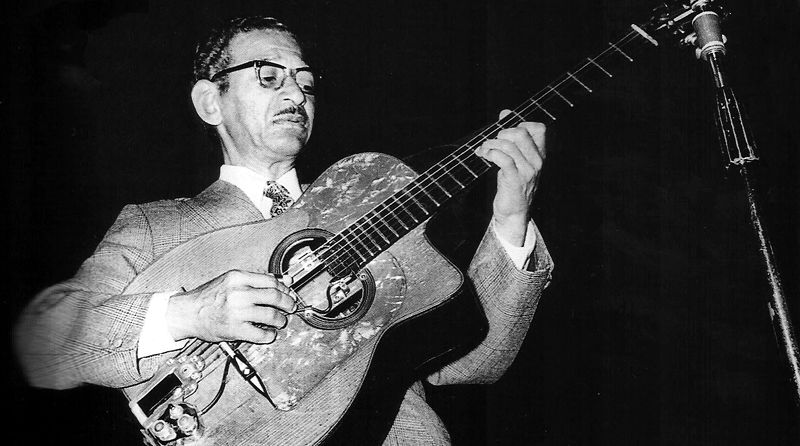
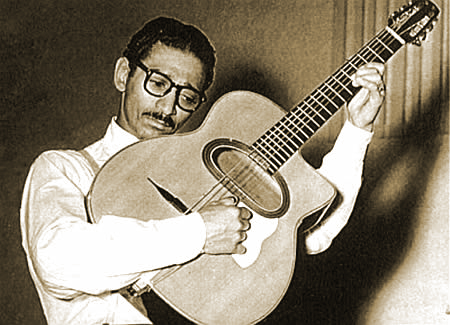
Oscar Alemán's significance lies in his role as a bridge between Argentine folk music, tango, and American jazz, and as a pioneering Afro-Argentine musician on the international stage. His work with Josephine Baker and friendships with Django Reinhardt, Louis Armstrong, and Duke Ellington placed him at the heart of 1930s European jazz. His playing style—using thumb pick and fingers on a D-hole Selmer Maccaferri guitar—distinguished him from Reinhardt's pick technique. Alemán's legacy endures through the Festival Oscar Alemán, an international jazz guitar festival created in his honor in 2002, and through documentaries and graphic novels that depict his life. His discography spans from 1927 to 1980, and his recordings continue to be reissued, ensuring his place in jazz history as a versatile and influential guitarist.
Did You Know?
- Alemán was orphaned at age 10 after his mother died and his father committed suicide.
- He led Josephine Baker's band, the Baker Boys, at the Cafe de Paris in the 1930s.
- He played a D-hole Selmer Maccaferri guitar, the same model used by Django Reinhardt.
- An international jazz guitar festival, Festival Oscar Alemán, was created in his honor in 2002.
Roots in Chaco and the Street
Oscar Marcelo Alemán entered the world on 20 February 1909 in Machagai, a small town in Chaco Province, deep in northern Argentina. He was the fourth of seven children born to Marcela Pereira, a native Argentine pianist, and Jorge Alemán Morales, a man of Uruguayan heritage who led a folk quartet alongside his own children Carlos, Juan, and Jorgelina. Music was simply the air the family breathed. By the age of six, young Alemán had already joined the Moreira Sextet, his family's traveling ensemble, first handling the cavaquinho—a small chordophone in the ukulele family—before settling on the guitar. The group carried their sound across Buenos Aires stages, including the Parque Japonés, the Nuevo Theater, and the grand Luna Park, and even crossed into Brazil for a tour. Then tragedy struck at ten: his mother died and his father took his own life, leaving Alemán to survive on the streets of Santos, Brazil, as a sporadic dancer and musician. Once he scraped together enough coins, he bought a guitar and formed the duo Los Lobos with Brazilian guitarist Gastón Bueno Lobo, playing party venues until the pair relocated to Buenos Aires in 1925 to work under comedian Pablo Palitos.
Paris, Jazz, and the Baker Boys
In 1929 Alemán and his partner crossed the Atlantic with dancer Harry Fleming, and after the European tour concluded he chose to remain in Madrid, performing as a solo guitarist. It was during the 1930s that American jazz first reached him through recordings by Eddie Lang and Joe Venuti, a discovery that reshaped his musical direction. He soon moved to Paris, where Josephine Baker hired him to lead her band, the Baker Boys, at the Cafe de Paris. That position gave him nightly access to American musicians who traveled to see Baker and joined her ensemble. It was in that orbit that he met Django Reinhardt, for whom he occasionally filled in as a substitute. Their friendship ran deep: Alemán recalled visiting Django's wagon, sleeping and eating there, and playing together purely for their own pleasure. He noted that Django always used a pick while he himself played with his fingers, a difference that shaped their respective approaches. Throughout the decade Alemán toured Europe both within Baker's band and on his own, sharing stages with Louis Armstrong and Duke Ellington, before assembling a nine-piece orchestra that performed nightly at the Le Chantilly in Paris.
Homecoming, Family, and the Long Twilight
When the Nazi invasion of France forced him to leave Europe during World War II, Alemán returned to Argentina and was celebrated as the country's most prominent Afro-Argentine jazz musician. He secured a residency at the prestigious Alvear Palace Hotel and scored a hit with "Rosa Madreselva," a swing interpretation of "Honeysuckle Rose." He continued to record and perform with both a swing quintet and a larger nine-piece orchestra. During this period he became romantically involved with actress Carmen Vallejo, and their daughter Selva Alemán, born in 1944, would go on to become a renowned actress in her own right (she passed in 2024). Alemán's popularity held strong into the late 1950s, but the arrival of rock and roll and the evolution of tango toward more popular forms gradually eroded his audience. He did not simply fade away: in 1972 he recorded a new album and reissued earlier material, continued touring, and made television appearances. He kept performing and teaching in Argentina until his death from an undisclosed illness on 14 October 1980, at the age of seventy-one.
Instruments, Style, and Enduring Legacy
Alemán's technical identity was distinct. He typically played with a thumb pick combined with his fingers, a hybrid approach that set him apart from pick-only players. His primary instrument was a D-hole Selmer Maccaferri archtop—the same model favored by Django Reinhardt—but his collection also included a National Style 1 tri-cone resonator guitar, nylon-string guitars, and other archtops, reflecting the breadth of genres he navigated. His recorded output spans more than five decades, from the 1927–1929 sessions in Buenos Aires through the 1979–1980 recordings, with Paris and Madrid also contributing to his discography. He also appeared in two films: Three Argentines in Montmartre (1941) and Buenos Aires Sings (1947). His cultural footprint extends well beyond the music: the documentary Oscar Aleman: Vida Con Swing, directed by Hernán Gaffet, and the French graphic novel Le Roi Invisible by Gani Jakupi both chronicle his life. In 2002, an international jazz guitar festival bearing his name was established, ensuring that new generations of players continue to encounter his swing.
Gallery
Frequently Asked Questions
Who is Oscar Alemán?
Oscar Marcelo Alemán (1909–1980) was an Afro-Argentine jazz musician, guitarist, singer, and dancer born in Machagai, Chaco Province. He is best known for his international career that included leading Josephine Baker's band in Paris and for his close friendship with Django Reinhardt.
What instruments and roles did Oscar Alemán perform?
Alemán was a multi-instrumentalist who played guitar and also sang and danced as part of his live performances. His versatility across instrumental, vocal, and dance roles set him apart in the jazz scene of his era.
How did Oscar Alemán end up leading Josephine Baker's band?
After starting out performing on the streets in Brazil, Alemán built a reputation that carried him to Paris, where he was given the opportunity to lead Josephine Baker's band. That role became his most widely cited claim to international fame.
What was Oscar Alemán's connection to Django Reinhardt?
While based in Paris, Alemán became a close friend of the legendary guitarist Django Reinhardt. Their mutual respect and collaboration are often cited as a highlight of his European years.
Why is Oscar Alemán considered important in Argentine jazz history?
As a prominent Afro-Argentine artist, Alemán played a key role in introducing and popularizing swing music within Argentina. His career bridged the gap between the country's local music scene and the broader international jazz world.
More in Latin jazz musicians 1-24
Spotted an error? Know more?
This is a living reference — every entry is fact-audited, and reader corrections feed straight into our audit queue. Suggest an edit · See this site's audit record