
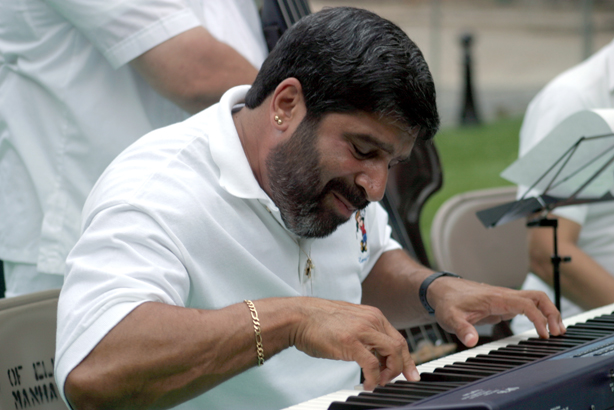
Gilberto "Pulpo" Colón Jr.
Pianist who worked with the Big 3 and Héctor Lavoe.

Cesoto · CC BY-SA 4.0
Gilberto "Pulpo" Colón Jr. (born December 28, 1953) is a pianist, composer, and bandleader known for having performed with all three of the "Big 3" orchestras: those of Tito Puente, Tito Rodriguez, and Machito. His family relocated from Puerto Rico to the Bronx in the 1940s, before he was born. Colón’s early musical tastes ranged from The Beatles and Elvis Presley to Puerto Rican jíbaro music. He started his formal music career at age 14, and after trying several instruments, he began piano lessons with a teacher recommended by Charlie Palmieri. Under the guidance of piano master Charlie Palmieri, he quickly gained the skills needed to succeed in a competitive field. As a teenager, he was already playing during the peak of Salsa’s Golden Age.
Colón entered New York City’s Latin circuit and joined Rafi Val y La Diferente, making his recording debut on the group’s self-titled 1971 album. He continued recording with them on *La Sociedad* (1972) and *Fuerza Bruta* (1974). After leaving La Diferente, he worked steadily with Louie Ramirez, Justo Betancourt, Marty Galagarza y La Conquistadora, Joe Cuba, and Andy Harlow.
In the winter of 1975, Héctor Lavoe asked Colón to join his orchestra. Colón’s first recording with Lavoe was on the 1978 Fania album *Comedia*. His extended piano solo on the track “Bandolera” became a signature moment, widely celebrated for its virtuosity and influence on Latin music. The solo is still regarded as one of the most historic piano solos on a commercial salsa album. Colón served as Lavoe’s pianist and musical director for 16 years, touring the world with the salsa icon. Alongside Lavoe and the Big 3, he has performed and recorded with artists including Adalberto Santiago, Kako, Pete “El Conde” Rodríguez, and La Bruja.
Colón has played piano on numerous recordings, including those by Rafi Val y La Diferente, Marty Galagarza y La Conquistadora, Alfredo “Chocolate” Armenteros, Andy Harlow, Charanga 76’, Pete “El Conde” Rodríguez, Héctor Lavoe, Tito Rodriguez Jr., Latin Percussion (three volumes of *Drum Solos*), Orquesta Novel, La Salsa Mayor, Don Gonzalo Fernandez, Charanga La Tapa, Machito & Salsa Big Band, Louie Ramirez, Frankie Morales, Adalberto Santiago, Junior Gonzalez, and A.J. Diaz y Son De La Calle. He also released his own solo a
- born
- December 28, 1953
- field
- Pianist, composer, band leader
- nationality
- Puerto Rican (family moved to United States in 1940s)
- known_for
- Working with all three of the "Big 3" (Tito Puente, Tito Rodriguez, & Machito Orchestras); extended piano solo on 'Bandolera'; 16 years as Héctor Lavoe's pianist and musical director
Lore & Background
Colón's family moved to the United States from Puerto Rico in the 1940s and settled in the Bronx, before his birth. His early musical influences ranged from The Beatles, Elvis Presley to Puerto Rican “Jibaro” music. He formally began his musical career at age 14, and after experimenting with various instruments, he began piano lessons with a teacher recommended by Charlie Palmieri. Under the tutelage of Charlie Palmieri, Colón quickly learned essential skills and began playing as a teenager at the epicenter of Salsa's Golden Age.
Colón made his recording debut with Rafi Val y La Diferente on their self-titled album (1971), continuing on subsequent albums. He then worked consistently with Louie Ramirez, Justo Betancourt, Marty Galagarza y La Conquistadora, Joe Cuba, and Andy Harlow.
In the winter of 1975, Héctor Lavoe asked Colón to join his orchestra. Colón’s first recording with Lavoe was on the 1978 Fania album *Comedia*. His extended piano solo on the track “Bandolera” became a defining moment in salsa, widely celebrated for its technical brilliance and influence. The solo remains one of the most historic piano solos on a commercial salsa album. Colón served as Lavoe’s pianist and musical director for 16 years, touring the world with the salsa icon. Alongside Lavoe and the Big 3, he has performed and recorded with artists including Adalberto Santiago, Kako, Pete “El Conde” Rodríguez, and La Bruja.
Reader's Guide
Gilberto "Pulpo" Colón Jr. holds a significant place in Latin music history as a pianist who performed and recorded with all three of the "Big 3" orchestras (Tito Puente, Tito Rodriguez, & Machito). His 16-year tenure as Héctor Lavoe's pianist and musical director placed him at the center of salsa's most iconic era. The piano solo on 'Bandolera' from Lavoe's Comedia album is considered one of the most historic piano solos ever recorded on a commercial salsa album, and the award for it, despite an editorial mistake, brought Colón to the forefront of Latin music's notable musicians. His extensive discography includes work with numerous leading artists, and his solo album Pulpo's Hot Bread won the 2009 Independent Music Award for 'Best Latin Album', demonstrating his continued relevance as a band leader and arranger. Colón's career reflects the evolution of salsa from its golden age through later decades, and his collaborations document a broad network of influential musicians.
Did You Know?
- Colón's family moved to the United States from Puerto Rico in the 1940s and settled in the Bronx.
- His early musical influences included The Beatles, Elvis Presley, and Puerto Rican “Jibaro” music.
- He studied piano under the tutelage of Charlie Palmieri.
- His piano solo on 'Bandolera' from Héctor Lavoe's Comedia album earned the award of 'Best Latin Piano Solo of the Year', though initially awarded to Professor Joe Torres due to an editorial mistake.
Roots in the Bronx: A Young Pianist's Formation
Gilberto Colón Jr. entered the world on December 28, 1953, but his story as a musician was shaped in the Bronx, where his family had relocated from Puerto Rico during the 1940s. Growing up in that vibrant neighborhood, the young Colón absorbed a wide spectrum of sounds: the rock-and-roll energy of Elvis Presley and The Beatles blended with the rhythms of Puerto Rican Jibaro music. By the age of fourteen, he had committed himself to a formal musical path, though he first experimented across several instruments before settling on the keyboard. A pivotal partnership formed when he and his close friend Oscar Hernández began taking piano lessons together under the guidance of Charlie Palmieri, a towering figure in Latin piano. Palmieri's tutelage gave the teenage Colón the technical foundation and musical vocabulary he needed to navigate the fiercely competitive New York scene. By the time he was still a teenager, he was already performing at the very heart of what would become known as Salsa's Golden Age, a testament to how quickly his raw talent translated into professional readiness.
The Lavoe Partnership and the 'Bandolera' Solo
In the winter of 1975, Héctor Lavoe reached out to Colón with an invitation that would define the next sixteen years of his career. Their first studio session together was captured in 1977 for the acclaimed Fania Records release Comedia, and it was on that record that Colón delivered the extended piano solo on 'Bandolera'—a performance that went on to win the award for Best Latin Piano Solo of the Year. There was a twist: the honor was initially misattributed to former Lavoe pianist Professor Joe Torres due to an editorial error, but once corrected, the recognition catapulted Colón into the front ranks of Latin music's most celebrated instrumentalists. To this day, that solo is regarded as one of the most historic piano performances ever captured on a commercial salsa record. Over the course of his sixteen-year tenure as Lavoe's pianist and musical director, Colón toured the globe alongside the Salsa Icon, cementing a partnership that remains a cornerstone of the genre's history.
A Career Spanning the Big Three and Beyond
Few musicians can claim the distinction Colón holds: he is credited with working alongside all three of the so-called Big 3 orchestras—Tito Puente, Tito Rodríguez, and Machito. His professional journey in the studio began in 1971 when he joined the young Rafi Val y La Diferente ensemble, contributing piano to their self-titled debut album. He remained with the group through La Sociedad in 1972 and Fuerza Bruta in 1974, building a solid foundation in the New York Latin circuit. From there his roster of collaborators expanded dramatically: Louie Ramirez, Justo Betancourt, Marty Galagarza y La Conquistadora, Joe Cuba, Andy Harlow, and Alfredo 'Chocolate' Armenteros all featured his keyboard work. Beyond the Big 3 and Lavoe, Colón's piano appears on recordings by Adalberto Santiago, Kako, Pete 'El Conde' Rodríguez, La Bruja, Frankie Morales, and numerous others. His discography stretches across decades and subgenres within the Latin world, a testament to a versatile player who was in demand across the entire ecosystem of salsa and related styles.
Pulpo's Hot Bread and a Lasting Legacy
After decades of lending his extraordinary piano to some of Latin music's most iconic voices, Colón finally stepped forward as a bandleader and composer in his own right. His first solo album, Pulpo's Hot Bread, arrived to critical acclaim and earned the 2009 Independent Music Award for Best Latin Album. On that project he wore multiple hats—pianist, musical director, and arranger—while assembling a lineup of some of the finest musicians working in the Latin world at the time. The record stood as a capstone to a career that had already seen him sit at the keyboard for the Big 3 orchestras, serve as Héctor Lavoe's musical director for sixteen years, and contribute to an extensive catalog spanning from the early 1970s through the 2000s. Born in 1953 and raised in the Bronx, Colón had grown up in the shadow of giants and, through sheer skill and relentless work, risen to stand alongside them. His nickname 'Pulpo' became a fitting emblem for a musician whose influence touched virtually every corner of the salsa universe, from the Fania Records studios to live stages around the world.
Gallery
Frequently Asked Questions
Who is Gilberto "Pulpo" Colón Jr.?
He is a pianist, composer, and bandleader born on December 28, 1953, to a Puerto Rican family that had emigrated to the Bronx in the 1940s. He became one of the most respected keyboard players in the Latin jazz and salsa worlds.
What is Gilberto "Pulpo" Colón Jr. best known for?
His most celebrated achievement is having performed with all three of the legendary "Big 3" salsa orchestras—Tito Puente, Tito Rodríguez, and Machito. He is also widely remembered for his extended piano solo on the classic track "Bandolera."
What was his role with Héctor Lavoe?
Colón served as both pianist and musical director for the iconic singer Héctor Lavoe over a span of sixteen years. During that partnership he shaped much of the harmonic and rhythmic foundation behind Lavoe's most memorable recordings.
How did Gilberto "Pulpo" Colón Jr. get into music?
He began his formal training at the age of fourteen after experimenting with several instruments before settling on the piano. His first piano teacher was recommended to him by the renowned pianist Charlie Palmieri, who went on to mentor his development.
Why is Gilberto "Pulpo" Colón Jr. important to Latin jazz history?
He is one of the very few pianists to have performed with all three of the era's dominant orchestras, linking the musical traditions of Puente, Rodríguez, and Machito in a single career. His long collaboration with Lavoe and his work across multiple major bands make him a central connective figure in the genre's golden era.
More in Latin jazz musicians 1-24
Spotted an error? Know more?
This is a living reference — every entry is fact-audited, and reader corrections feed straight into our audit queue. Suggest an edit · See this site's audit record